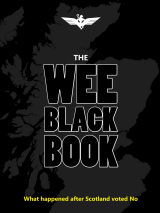
Watchful readers will know that one of the recurring themes on this site is the impossibility of finding any real ideological differences between the three main Westminster-based parties. But to be scrupulously fair, we think we might finally have uncovered one now, in the light of this week’s bizarre Lib Dem policy paper on Trident.

(This is turning into the worst day off ever.)
Read the rest of this entry →
Category
analysis, scottish politics, uk politics
Having done it for 22-and-a-half years now, we’re unable to recommend a career in journalism. While there are upsides, it’s a largely arduous and thankless task, and one where pay rates were on a downward slope long before the financial crisis.

However, if for some unfathomable reason you’re really determined that it’s the job for you, let us at least offer you a crash course in the modern art.
Read the rest of this entry →
Tags: misinformationproject fear
Category
analysis, media, scottish politics
Lord George “Devolution will kill nationalism stone dead” Robertson of Port Ellen is among several ennobled former Defence Secretaries who’ve been busying themselves with writing to the press this week. And for once, it’s not about dog dirt and potholes.
As well as being co-signatory with several other Conservative and Labour peers to a letter in the Telegraph urging the UK to commit to a like-for-like replacement of Trident, Robertson also bothered the Herald with a missive aiming to “nail some wild assertions and fallacies about Scottish public opinion on the subject”.

We could score a cheap point here by noting that the befuddled pensioner apparently thinks the SNP secured 45% of the vote “in the 2010 General Election” – rather than in the Holyrood one the following year – but instead we’ll point out the ermine-clad statesman’s rather more serious attempt to mislead.
Read the rest of this entry →
Tags: misinformation
Category
analysis, comment, scottish politics, uk politics
The No campaign is fond of mocking the SNP’s insistence that an independent Scotland could be a member of NATO while still getting rid of Trident. The USA in particular, it’s frequently argued, would simply not stand for the Scots taking the strategic base at Faslane out of the North Atlantic picture while still seeking the benefits of the alliance’s military presence and protection.

If only there was some sort of precedent we could examine.
Read the rest of this entry →
Tags: Angus McLellan
Category
analysis, scottish politics, world
The Times got rather huffy with Alex Salmond this week, when in a speech at a Nigg engineering yard the First Minister made the not-entirely-controversial suggestion (or in the Times’ view, “an unprecedented attack”) that the Scottish and UK printed press was biased against the independence movement.

(Or, as the irony-bereft paper impartially put it, “him and his plans for separation”.)
Read the rest of this entry →
Category
analysis, comment, media, scottish politics
The Herald publishes a rather interesting story today, revealing that according to professional media analysts Brandwatch, almost three quarters of social media users in Scotland are planning to vote Yes in the referendum.

(For some reason the Herald chose to publish the piece under the headline “Davey doubts Scotland will reach green energy target”, which we’ll put down to the heat, and to emphasise the notion that the high level of support was “despite” the SNP.)
Read the rest of this entry →
Category
analysis, comment, media, scottish politics
We’ve been substantially updating yesterday’s feature on the financial strength of an independent Scotland, based on the calculations by the pro-Union economist Prof. Brian Ashcroft. Thanks to the readers who pointed out some of the finer detail.

The results, we think you’ll agree, are pretty breathtaking.
Read the rest of this entry →
Category
analysis, comment
We have a bit more respect for Professor Brian Ashcroft than most of the No camp’s scaremongers (indeed, we’ve even run an article of his on Wings Over Scotland), so we looked with interest at the latest entry on his blog yesterday, a piece with the fairly self-explanatory title of “Has Scotland already spent its oil fund?”

It purports to examine what Scotland’s financial position would have been had it been independent for the last 32 years, in response to a Scottish Government document (which was backed up by fullfact.org) showing that Scotland had been a large net contributor to the UK over the period, but arrives at a bizarrely tangential conclusion.
Read the rest of this entry →
Category
analysis, reference, scottish politics, stats
We meant to mention this in yesterday’s post about the Future Of England Survey, but it was so hot the part of our brain holding the thought got incinerated when we foolishly went to the corner shop to buy some milk without an asbestos hat on.

52% of the good people of England believe Scotland gets “more than its fair share” of UK public spending, with only 19% thinking the distribution of cash was “pretty much fair”. Almost as many (49%) think Scotland benefits the most financially from the Union, compared to just 23% who say both nations do equally well and therefore, at most, 28% who think England gets the best deal.
(Oddly, the survey doesn’t actually put a figure to the latter.)
81%, meanwhile, think Scottish MPs should butt out of parliamentary matters that only affect England and Wales (although this neglects to consider the knock-on effect on the Barnett formula, which can impinge on devolved matters).
Why, then, do only 30% of them support Scottish independence?
Read the rest of this entry →
Tags: vote no get nothing
Category
analysis, uk politics
We’ve spoken before of the difficulty of empirically demonstrating anti-independence bias in the Scottish and UK media, because of the relative rarity of directly comparable situations. So today we’re pleased to see one of them present itself.

Michael Gray of National Collective recently visited Scandinavia and did a nice bit of journalism, securing quotes from a number of senior Danish politicians to the effect that an independent Scotland’s membership of the EU would be “a mere formality” and that the subject was “a non-issue”.
Good news. But how does it help us illustrate media bias?
Read the rest of this entry →
Category
analysis, europe, media, scottish politics
Diligent readers will, we have no doubt recall, that the No campaign chairman, Alistair Darling, has made abundantly clear the conditions of any future enhanced devolution settlement for Scotland in the aftermath of a No vote in 2014:
“If you are going to stand on any platform of constitutional change you are duty bound to put it in a UK manifesto. It is not about a veto it is about having a mandate for it.”
Darling’s position couldn’t be less ambiguous – if Scotland rejects independence, any additional powers for the Scottish Parliament will be subject to the approval of the voters of the rest of the UK (chiefly England, which supplies around 90% of them).

But do we know how the good folk of South Britain are likely to view such a prospect?
Read the rest of this entry →
Tags: captain darlingvote no get nothing
Category
analysis, uk politics
We’ve explored the “Kinnock Factor” previously on this site, but some numbers from the latest YouGov weekly polling surprised even us today. Labour’s lead over the midterm Conservative-led government is still falling – to just 6% this time – and Ed Miliband’s personal ratings are even worse than David Cameron’s, but that wasn’t it.

You’ll probably want to click on that image to enlarge it.
Read the rest of this entry →
Tags: Kinnock Factor
Category
analysis, scottish politics, stats, uk politics