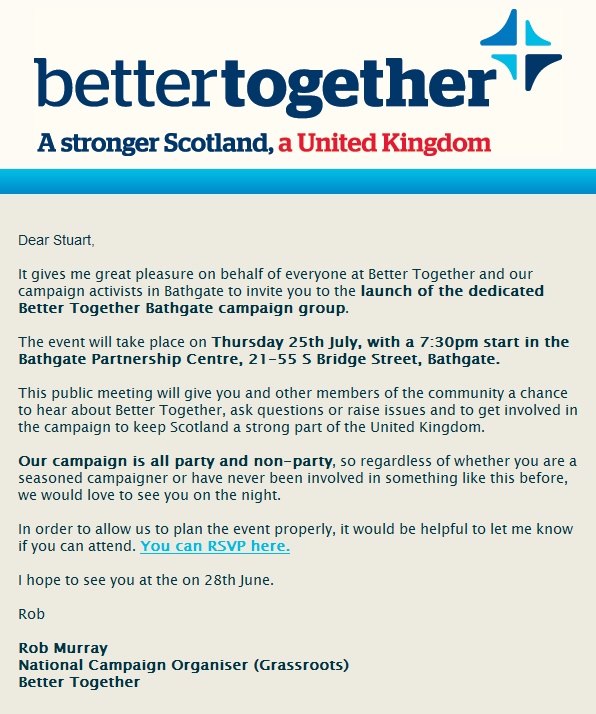
As we noted earlier, the Wings Over Scotland spy at last night’s “Better Together” meeting in our home town of Bathgate last night wasn’t alone. Some intrepid readers also attended the event, and recorded the whole thing to find out what the No campaign are telling people away from the scrutiny of the media.
It’s a grim watch, but we’ve picked you out some highlights.
Read the rest of this entry →
Category
analysis, scottish politics, transcripts
Tonight saw the launch of “Better Together Bathgate”, the No camp’s debut foray into our beloved hometown. The email advertising the event, sent out on the 15th of July, said “I hope to see you at the on 28th June” [sic], which might help to explain the rather sub-spectacular turnout of around 40 hardy souls from a town of 16,000.

Of that 40 or so, several (perhaps as many as a quarter) were dastardly pro-Yes spies. And we know that for certain, because one of them was ours.
Read the rest of this entry →
Tags: flat-out liesmisinformationproject fear
Category
analysis, comment, scottish politics
In an extraordinary outburst on TV last night, “Better Together” campaign chairman Alistair Darling accused Alex Salmond of exaggerating the amount of extractable oil in the Scottish sector of the North Sea by 1,200%.
The former Chancellor (who we learned a few weeks ago thinks the population of Scotland is six million, creating an impressive 705,000 imaginary Scots) suggested that rather than the 24 billion barrels currently estimated by the oil industry – and commonly cited by the UK government – there were in fact just 2 billion barrels left.

As BT are a tad wobbly with numbers, let’s do a quick bit of arithmetic on that.
Read the rest of this entry →
Tags: arithmetic failcaptain darlingflat-out liesmisinformationproject fearthe positive case for the uniontoo wee too poor too stupid
Category
analysis, scottish politics, stats
We linked you yesterday to a quite startling display of cognitive dissonance, as a dedicated Labour activist struggled to reconcile his party’s position on Trident with his own belief in disarmament, reaching some quite extraordinary contortions of logic in an attempt to convince himself that staying in the Union represented the best way of ridding the United Kingdom of weapons which are enthusiastically supported by every major UK political party and the Lib Dems.

But it’s not just mad bloggers who are frantically trying to whip up a sandstorm of spin to obscure Labour’s final abject surrender to the nuclear weapons lobby.
Read the rest of this entry →
Tags: misinformation
Category
analysis, media, scottish politics, uk politics
In Alan Moore’s legendary graphic novel “V For Vendetta”, the central character tells co-protagonist Evey: “Silence is a fragile thing. One loud noise, and it’s gone”.

Yesterday we ran a guest post from the Scrap Trident Coalition calling for an end to the Johann Lamont and the Scottish branch of the Labour Party to end its silence on the subject of nuclear weapons.
But though Lamont remains “on holiday” and unavailable for comment on a range of issues (or even completely excluded from discussing them at all), her party has ended her silence for her, with a succession of loud noises nobody could possibly miss.
Read the rest of this entry →
Category
analysis, scottish politics, uk politics
Careful readers will be aware that this site primarily concerns itself with the activities of politicians and the media. Doing so can of course leave the way open to accusations of paranoia and conspiracy theorising. So we thought it might be interesting to share with you the findings of Transparency International’s 2013 survey into the public perception of corruption in the United Kingdom. (Part of a global poll.)

The only three bodies thought to be corrupt or extremely corrupt by a majority of the UK population were political parties, Parliament and the media, with the media coming off worst out of the three. (Next up, incidentally, were “business” with 49% and “public officials/civil servants” with 45%.)
Perception isn’t necessarily fact, of course. But at the very least, it’s not just us.
Category
analysis, comment, culture, uk politics
Apologies if the headline falls fouls of anyone’s work filter (although it shouldn’t, as it’s officially legally not a swear word), but we can’t think of a more concise and accurate way of describing the phenomenon illustrated by the comically absurd story that’s being blared all over the Scottish media this morning like news of the Apocalypse.

The price of oil, as the No campaign never tires of telling us, is volatile. Nobody knows what it’ll be in 27 weeks’ time, or even 27 days’ time. Predicting what level it’ll be at 27 hours from now is pushing your luck a bit, and City traders regularly make and lose fortunes betting on that timescale and getting it right or wrong.
So the idea that anyone, let alone the Office for Budget Responsibility, can have even the slightest, vaguest hint of a clue where North Sea oil prices and production will be 27 YEARS from now is – well, see the headline.
Read the rest of this entry →
Tags: crystal bollocksmisinformationproject fear
Category
analysis, comment, scottish politics, uk politics
Watchful readers will know that one of the recurring themes on this site is the impossibility of finding any real ideological differences between the three main Westminster-based parties. But to be scrupulously fair, we think we might finally have uncovered one now, in the light of this week’s bizarre Lib Dem policy paper on Trident.

(This is turning into the worst day off ever.)
Read the rest of this entry →
Category
analysis, scottish politics, uk politics
Having done it for 22-and-a-half years now, we’re unable to recommend a career in journalism. While there are upsides, it’s a largely arduous and thankless task, and one where pay rates were on a downward slope long before the financial crisis.

However, if for some unfathomable reason you’re really determined that it’s the job for you, let us at least offer you a crash course in the modern art.
Read the rest of this entry →
Tags: misinformationproject fear
Category
analysis, media, scottish politics
Lord George “Devolution will kill nationalism stone dead” Robertson of Port Ellen is among several ennobled former Defence Secretaries who’ve been busying themselves with writing to the press this week. And for once, it’s not about dog dirt and potholes.
As well as being co-signatory with several other Conservative and Labour peers to a letter in the Telegraph urging the UK to commit to a like-for-like replacement of Trident, Robertson also bothered the Herald with a missive aiming to “nail some wild assertions and fallacies about Scottish public opinion on the subject”.

We could score a cheap point here by noting that the befuddled pensioner apparently thinks the SNP secured 45% of the vote “in the 2010 General Election” – rather than in the Holyrood one the following year – but instead we’ll point out the ermine-clad statesman’s rather more serious attempt to mislead.
Read the rest of this entry →
Tags: misinformation
Category
analysis, comment, scottish politics, uk politics
The No campaign is fond of mocking the SNP’s insistence that an independent Scotland could be a member of NATO while still getting rid of Trident. The USA in particular, it’s frequently argued, would simply not stand for the Scots taking the strategic base at Faslane out of the North Atlantic picture while still seeking the benefits of the alliance’s military presence and protection.

If only there was some sort of precedent we could examine.
Read the rest of this entry →
Tags: Angus McLellan
Category
analysis, scottish politics, world
The Times got rather huffy with Alex Salmond this week, when in a speech at a Nigg engineering yard the First Minister made the not-entirely-controversial suggestion (or in the Times’ view, “an unprecedented attack”) that the Scottish and UK printed press was biased against the independence movement.

(Or, as the irony-bereft paper impartially put it, “him and his plans for separation”.)
Read the rest of this entry →
Category
analysis, comment, media, scottish politics