When I wrote previously about how Scotland’s export business does not depend on the UK (as had been claimed by Alistair Darling at last year’s Mackintosh Memorial Lecture), one of the questions I was asked was what export business Scotland has.
On Wednesday, in a piece lurking at the bottom of Scottish news section, the BBC reported a £1.6bn rise in Scottish exports. The Global Connections Survey (GCS) – full report here – showed that exports were up to record highs both to the rest of the UK and to the rest of the world. Scotland’s exports to the rUK showed a value of £45.5 billion, and to the rest of the world they rose by the headlined £1.6bn, up to £23.9bn.

It’s worth noting that none of these statistics include oil (see page 2 of the report), despite the mention of “refined petroleum” below – we’ll deal with that another day.
Read the rest of this entry →
Tags: Stuart M Darling
Category
analysis, comment, stats
We’ve pilfered the files of the tremendous Scottish Political Archive before (you’ll have seen one here, for example), but in the light of today’s earlier post and a comment on it from an alert reader directing us to this fantastic piece about the 1979 No campaign, we’ve been rummaging around in there again. We particularly enjoyed this image (click to enlarge) and its contents, from a campaign group called “Scotland Is British”.

There’s pure gold in almost every line (we particularly enjoyed the description of independence as “ultimate separation” in section 4, and how everything predicted as a dire consequence of devolution in section 3 happened anyway without it), but the most familiar of the many top-drawer zingers was in section 6.
Read the rest of this entry →
Tags: flat-out lies
Category
analysis, media, scottish politics
We owe SNP communications officer Erik Geddes an indirect hat-tip for this one, as a link he posted to something else on Twitter led us to discover this superb piece from the Herald archives. It’s from the 28th of February 1979, the day before the first referendum on Scottish devolution – the one which resulted in a Yes vote, but which was rejected on the grounds of a rigged amendment by a Scottish Labour MP, delaying the return of a Scottish parliament for 20 years.

It’s absolutely startling to read the “No” responses and see just how indistinguishable most of the dire warnings about the consequences of an “Assembly” are from the arguments against independence we hear now, and to also note how few of them (in fact, none) came true when devolution finally arrived.
Read the rest of this entry →
Tags: too wee too poor too stupid
Category
analysis, comment, media, scottish politics
Earlier today we had a wee pop at the Herald for the headline of this story:

The reason for our complaint was what we felt to be the misrepresentation of a poll asking a multiple-choice question about the Scottish constitution:
“What clearly WOULDN’T be fair, though, would be to present those statistics as a drop in the “Yes vote”, because the SSAS’s multiple-optioned findings on an obsolete 14-year-old form of a “constitutional preference” poll bear no relation whatsoever to any “Yes/No” question that’ll be asked in 2014.”
So it was a nice surprise to later, by sheer chance while browsing around for nothing in particular, happen across the same story with a slightly different tone. Evidently the paper had listened to reasonable, fair criticism and taken admirably prompt action.
Read the rest of this entry →
Category
analysis, media, scottish politics
We should get one thing straight from the start: the only thing on Earth more tedious than a conspiracy theorist is a conspiracy denier. For every swivel-eyed nutter you find shouting hysterically that the government and royal family are 12-foot-tall shape-shifting lizards from space, there’ll be an equally (but differently) dim-witted Pollyanna at the other end glibly sniggering about “tinfoil hats” and rubbishing the mad notion that a group of people might ever get together and covertly seek to achieve an aim.
Because the history of humanity is the history of conspiracies. From Guy Fawkes to various military coups, revolutions and civil wars to the burning of the Reichstag and right up to the present day, mankind’s records are littered with events which, had anyone actually warned of them before they happened, would have been dismissed by smug idiots as the deranged fantasies of the comically paranoid.

As recently as last year we saw one right here in our very own country, when the South Yorkshire police were found to have perpetrated a co-ordinated, decades-long cover-up over the Hillsborough tragedy. Yet like moths which keep flying into lightbulbs over and over again in the irrational hope that THIS time they’ll turn into the moon, we stubbornly refuse to entertain – indeed, openly mock – even the abstract possibility that anyone in a position of power might ever be up to no good.
So, then, to the Scottish media.
Read the rest of this entry →
Category
analysis, media, psephology, scottish politics
It’s almost too easy to take all the cheap shots that David Cameron’s much-trailed, long-awaited speech about UK membership of the EU left open.
From a Scottish perspective it was difficult to suppress a hollow laugh, for example, when the Prime Minister said of some prominent non-EU nations: “I admire those countries and they are friends of ours – but they are very different from us. Norway sits on the biggest energy reserves in Europe, and has a sovereign wealth fund of over €500bn“

It’s also tempting to simply marvel (again) at the mind-boggling witlessness of the “Better Together” campaign, who spent the final weeks of last year hollering from the rooftops about how Scottish independence might bring about the terrifying prospect of Scotland finding itself out of Europe, when they MUST have known that Cameron was about to make that same thing a far more real possibility within the UK than outside it.
(The No camp’s willingness to keep on energetically hurling hefty boomerangs at the independence movement, no matter how many come flying back and hit them in the teeth, is truly one of the wonders of the modern age.)
Read the rest of this entry →
Tags: hypocrisyvote no get nothing
Category
analysis, europe, scottish politics, uk politics
We’ve raised this subject before, but it was brought to mind again by a conversation we had on Twitter last night and this morning, and it never gets any less relevant. Opinion polls are tricky things. Let’s just remind ourselves of a few:
Who do you trust to act in Scotland’s best interests?
Scottish Government: 71%
UK Government: 18%
(Source: here. Also reported in Scotsman subsidiary Fife Today, but mysteriously now completely vanished from the internet.)
Which decisions about Scotland should be made by Holyrood?
All of them: 43%
The same ones as now: 21%
(Source: here, table A1. A “devo-max” option scored 29%.)
Should Scotland be an independent country?
Yes: 28%
No: 48%
(Source: here, although see here.)
Alert readers will of course have noticed (again) that these three questions are in fact all the same as each other. They all describe independence. Yet the answers are radically different. Scottish voters trust the Scottish Parliament to act in their best interests vastly more than they trust the UK Parliament. They think it should make all decisions about the governance of Scotland. Yet ask them if they want to vote to make that exact thing happen, and they change their minds completely.
There’s clearly a serious democratic disconnect here. What to do?
Read the rest of this entry →
Category
analysis, psephology, scottish politics
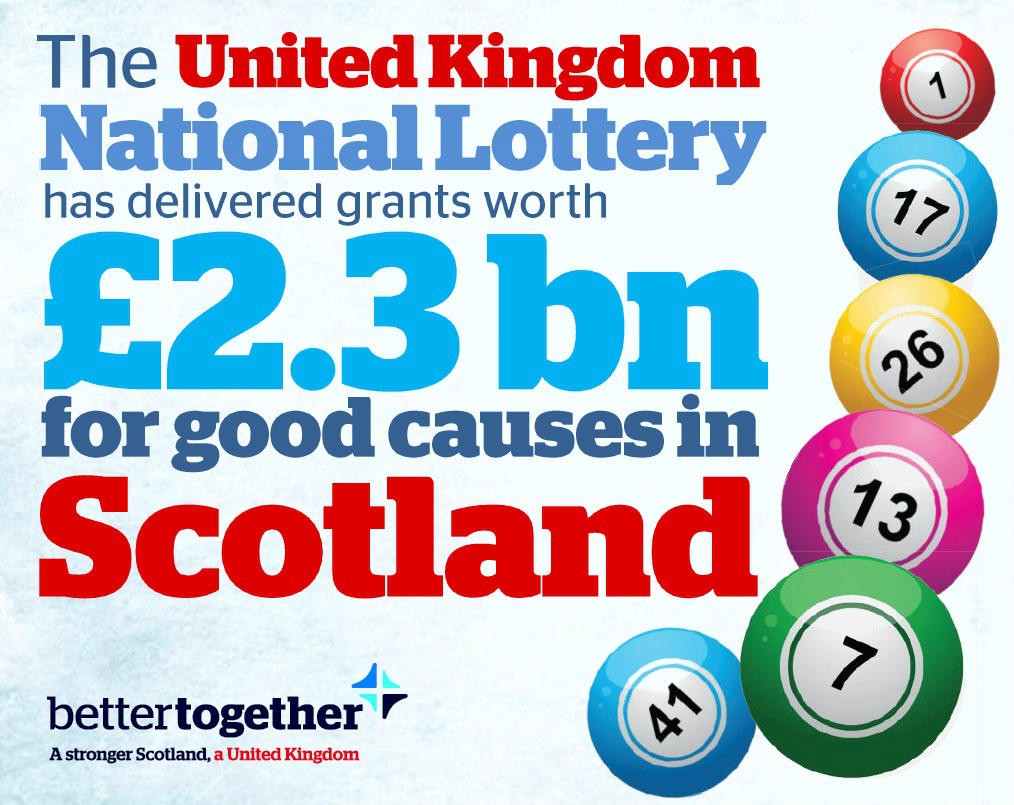
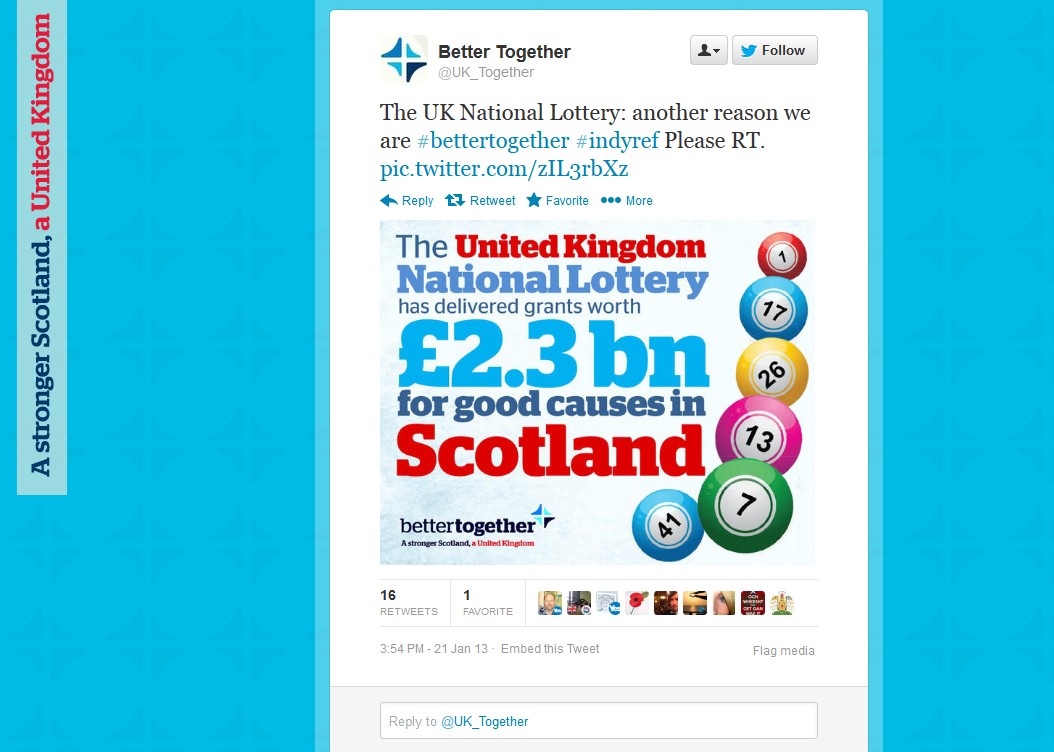
(We suspect this might become a regular series.) We try not to take any notice of the often-ludicrous propaganda churned out by the official “Better Together” campaign, but today’s was too utterly ridiculous to ignore. We’re not going to deface our nice pages with the image, though you can see it here if you want to without giving them any hits.

The graphic claimed, mind-bogglingly, that the award of £2.3bn in grants to good causes in Scotland by the National Lottery since its advent in 1993 was “another reason we are better together”, as if the figure represented some great largesse towards Scotland on the part of the UK. This, as any reader with an IQ higher than the number on a lottery ball will immediately realise, is such a monumental and obvious misrepresentation of how the lottery works that we can only concur with the Twitter user who enquired “When will the glue-sniffing stop at BT strategy HQ?”
Read the rest of this entry →
Tags: arithmetic failbrassneckconfused
Category
analysis, games, idiots, uk politics
There was an interesting article in today’s Herald entitled “SNP snub plan for more tax powers at Holyrood”. It centred around the latest report from the Institute of Public Policy Research, advocating a new form of further devolution settlement (dubbed “Devo More”) as a solution to Scotland’s problems rather than for independence.
The article itself was devoid of any analysis of the report’s findings, though in fairness to the Herald it did note that the IPPR “has close ties to Labour”, thereby alerting suspicious readers to potential bias within the document.

As far as many independence supporters are concerned, any offer of further devolution at this point is merely an empty promise of “jam tomorrow”. Had any Westminster party seriously intended to increase the level of devolution to Scotland, runs their argument, then they could have done so during the Calman Commission, the Scotland Act or more recently by including an offer of further devolution on the ballot paper for the 2014 independence referendum. They did none of these things.
Read the rest of this entry →
Tags: Federalists Unionists and DevolutionistsScott Mintovote no get nothing
Category
analysis, disturbing, uk politics
One of the most unfortunate things about the Scottish media’s coverage of the independence debate is the persistent portrayal of the Yes campaign as nothing more than a figleaf concealing the SNP. Recently we’ve pointed out the unwillingness of the press to acknowledge information that’s already in clear public view with regard to the demographic make-up of the pro-independence movement, even while making great play of the alleged comparative broadness of the No side.

So we decided to conduct our own poll, just out of curiosity, on a dozen random topics. With just shy of 1000 respondents it’s a respectable sample size, and while of course it isn’t scientific (being self-selecting) it wasn’t aiming to be. The large majority of this site’s readership is of the nationalist persuasion – for want of a better term, at least – so we weren’t trying to take a snapshot of all Scotland, but rather one specifically of the Yes movement. The results were pretty interesting.
Read the rest of this entry →
Category
analysis, scottish politics, stats
We’ve already highlighted the absurdity of the comments made by several Unionist politicians last week (in both the Commons and the Lords) about the Scottish Parliament being “undemocratic” and a “one-man dictatorship”. But we only mentioned Scottish representation in doing so. What about the whole UK?

The majority – 53% – of votes cast by the British electorate in 2010 were worthless, because they were cast for candidates who didn’t win the seat they contested and are therefore simply thrown in the bin by the “first past the post” electoral system. Thousands of people were locked out of polling stations across the country on the evening of the vote, but it didn’t really matter, because statistically speaking their vote would probably have been completely ignored anyway.
Read the rest of this entry →
Tags: hypocrisy
Category
analysis, stats, uk politics
Bless ’em, they’re getting closer. After some nagging, the Herald has now finally changed the story about jobs at Faslane that it printed a correction for earlier this week. And credit to them, the new version is a good 5% less wrong than the original.

Rather more distressingly, though, the newly-edited story still doesn’t match up even to the Herald’s own correction, never mind any kind of reality.
Read the rest of this entry →
Category
analysis, comment, media, scottish politics