Newsnight Scotland presenter Gordon Brewer got a bit exasperated on last night’s edition of the show as he tried, repeatedly but unsuccessfully, to get Scottish Labour’s ever-smirking Jackie Baillie to give him anything resembling a straight answer to a question about Labour’s (lack of) policy on the bedroom tax.

As the well-fed welfare spokeswoman embarked on another pre-scripted soundbite of SNP-bashing rather than commit Labour councils to a policy of not evicting tenants for arrears related to the penalty charge, Brewer sighed (at around 12m 52s) that “I was vainly trying to take into consideration the people who might be affected by this” before giving up and moving on to his other guest.
Baillie was demanding that the Scottish Government instead bring forward legislation to make such evictions illegal – just a few days after Scottish Labour’s press office had strenuously denied to this very website that the party was making any such demands. But it’s easy to see why she’d be having trouble keeping track of her position, because to Labour the bedroom tax is little short of a delight.
Read the rest of this entry →
Category
analysis, comment, scottish politics, scum, uk politics
We’re not sure we can untangle this.

Perhaps you can help us out.
Read the rest of this entry →
Tags: vote no get nothing
Category
analysis, scottish politics, transcripts
The media is in full-on spin mode today, reporting Ruth Davidson’s miraculous Damascene conversion to the principle of “more powers” for the Scottish Parliament, just 18 short months after her Churchill-esque declaration of devolutionary defiance to the effect that the petty tinkering of the Scotland Act was a “line in the sand”.
Most of the papers, of course, feign critical analysis by highlighting Davidson’s U-turn. But what we haven’t seen in a single one is any sort of actual examination of the content of Ms Davidson’s speech to a micro-audience of literally several people in what appeared to be the corridor of an Edinburgh hotel yesterday.

We suspect that’s because anyone who did would be very hard-pressed indeed to credibly describe the measures she proposes as representing “more powers” for anything. In fact, they’re the opposite.
Read the rest of this entry →
Tags: misinformationthe positive case for the unionvote no get nothing
Category
analysis, media, scottish politics
We don’t know about you, viewers, but when we tune into a two-hour TV programme called “Scottish National Party Spring Conference 2013”, we sort of expect the large bulk of that show to be, well, the Scottish National Party Spring Conference 2013.

With the UK’s state broadcaster, though, that isn’t necessarily the case.
Read the rest of this entry →
Category
analysis, media, scottish politics
We already know that Labour, particularly in Scotland, have no policies on just about anything. But in the light of the past week’s glut of abstentions, we decided to see if we could find out if the party had any remaining principles either. The results were startling, by which we mean not startling in the slightest.

Below are just a few of the votes that Labour has abstained on, at both Westminster and Holyrood, in recent memory. What, we ponder rhetorically, is the point of having an Opposition that doesn’t ever actually oppose anything?
Read the rest of this entry →
Category
analysis, comment, disturbing, scottish politics, uk politics
We’re only just now getting round to watching last night’s special edition of Newsnight Scotland. It’s off to a cracking start. Great work there, BBC Scotland graphics team.

Category
analysis, disturbing, media, scottish politics
Just for fun, then, let’s have our guesses. I’d love to see Alex Salmond stand up in Holyrood this afternoon and announce that the historic first chance for Scots to choose their own destiny will take place on Saturday 25th October 2014, because that means the result would arrive on my birthday the following Monday. But I don’t think he will.
The official Wings Over Scotland prediction is Thursday 2nd October 2014.
Read the rest of this entry →
Category
analysis, scottish politics
Well, what a curious day this is shaping up as. As we scoured our Twitter feed in vain after the bewildering media blackout on the workfare vote, we also discovered that “Better Together” has been running around half the internet trying to censor a satirical video. To cut a long story short, you can download a copy of the video by right-clicking on the image below and choosing “Save As…” or “Save Link As…”.
(NB: Don’t left-click, as it will attempt to stream it and fail.)
We invite the No campaign to see if they can have it pulled from this site.

But that wasn’t the end. As people started to read our story on the workfare motion, we began to get tweets and comments questioning the quote we’d used, as it didn’t seem to appear anywhere in the article on the website. Confused, we went and had a look, and sure enough the original version had vanished, replaced by something much shorter and far more innocuous.
Luckily this isn’t our first time with internet censorship. At the time of writing there’s still a cached version of the original, and when that disappears you can read it here.
We’re not quite sure what’s happening today, but we don’t like it.
Read the rest of this entry →
Tags: memory hole
Category
analysis, comment, disturbing, media, scottish politics, uk politics
The usage of Nazi terminology to refer to any actions of a democratically-elected UK government is nearly always an absurd and unhelpful exaggeration. Today, however, one such analogy is absolutely literally justified.

The words “Arbeit Macht Frei” were emblazoned, usually in iron, over the gates of numerous concentration and extermination camps in 1930s and 1940s Germany, most infamously Dachau and Auschwitz. The phrase is usually rendered in English as “work makes you free”, though a more precise translation of the first word is “labour”.
That the same exhortation is used in Britain in 2013 by The Salvation Army tells you all you need to know about the ideological climate of the modern United Kingdom.
Read the rest of this entry →
Category
analysis, culture, disturbing, uk politics
Diligent readers will know that this site is engaged in a lonely and difficult quest to find out what Labour’s actual policy on the Bedroom Tax is. And in attempting to establish the facts of the matter, it’s important to differentiate a policy from an opinion.
The latter are in plentiful supply – Labour, we’re told repeatedly, is “against” the tax. Check out, for example, this intriguing exchange on Twitter. (Click for full version.)
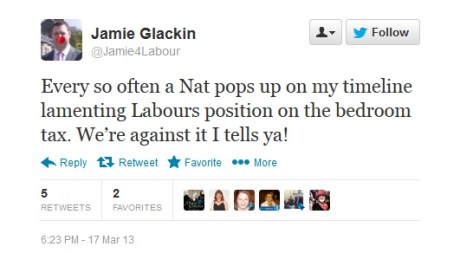
Jamie Glackin is a member of Labour’s Scottish Executive Committee, so you think he’d have a fairly firm grasp of the party’s policies, but he’s oddly evasive regarding the Bedroom Tax. Asked by SNP councillor Mhairi Hunter if Labour would scrap the tax, Glackin dodges by saying “Don’t think it will get that far. It’s a dead duck.”
But he’s far from alone in not wanting to answer that question.
Read the rest of this entry →
Category
analysis, scottish politics, uk politics
Brigadoon is the story of a Scottish village which only appears for one day every hundred years. GERSland, on the other hand, is a country – similar to Scotland in many ways – which has appeared, albeit fleetingly, every year since 1999.

GERSland too suffers from Caledonian Antisyzygy – it is simultaneously like Scotland and unlike it. It is not Scotland as we know it and it’s not a glimpse of an independent Scotland either, despite the dogged insistence of countless journalists, analysts and commentators less insightful than Wings Over Scotland’s on presenting it as such.
It is, as the lawyers say, sui generis, or a special case.
Read the rest of this entry →
Tags: Angus McLellan
Category
analysis, scottish politics, uk politics
Recent claims made by Jackie Baillie (Labour’s shadow health spokeswoman and Better Together campaign director) suggested that Scots would be unable to gain access post-independence to medical treatment in England, because a Yes vote would lead to cross-border reciprocal healthcare becoming bogged down by red tape, complexity and costs, leading to treatment being delayed or withheld.

As we’ve explained before, given that reciprocal agreements already exist between the UK and other countries in the European Economic Area (EEA) – in the form of the European Health Insurance Card (EHIC) – Baillie’s claim is at its most generous interpretation an absurdly ill-informed misunderstanding, and in a more depressingly plausible scenario, an outright lie.
Read the rest of this entry →
Tags: Scott Minto
Category
analysis, scottish politics