The 16K ZX Spectrum was definitely the ginger stepchild of the family of micros that defined home computing in the UK in the 1980s. With far less memory available to coders (just 9K) than a 16K ZX81, the £125 cost of the entry-level model – shockingly the equivalent of £416 now – didn’t get you all that much bang for your buck when it launched, even by the standards of April 1982.
The vast majority of purchasers wisely chose to save up the extra £50 for the 48K version (£175, or a hefty £582 in 2023 money, although still peanuts compared to the Commodore 64’s launch price of £1,327 equivalent), and the 16K Speccy very quickly fell out of favour. In fact it was withdrawn from sale after barely over a year on the shelves, with old stocks cleared at £99.
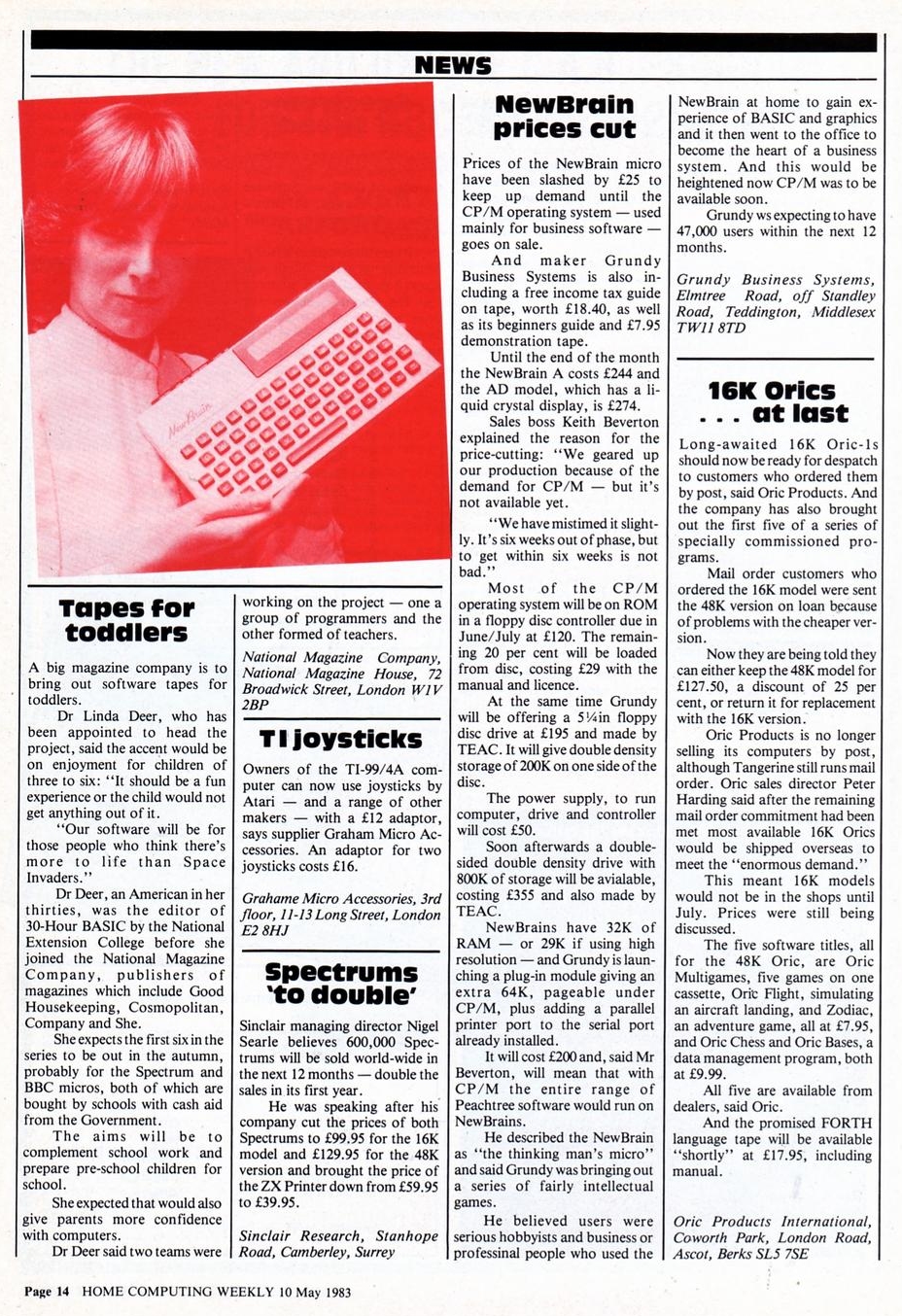
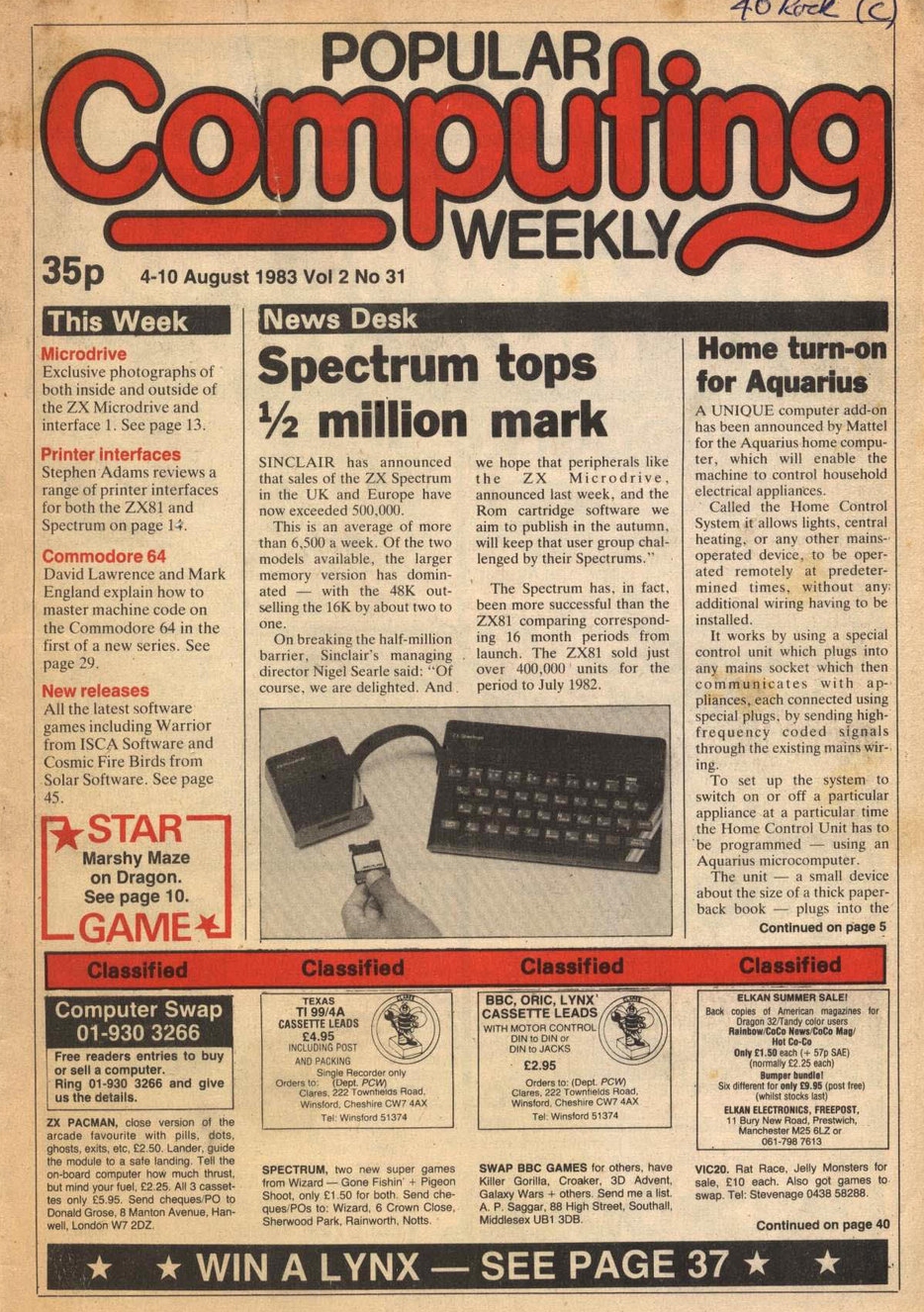
(There are no official figures for how many of the 5 million Spectrums sold were 16Ks, but Home Computing Weekly reported in May 1983 that 300,000 machines in total were sold in the first year, and in August 1983 Popular Computing Weekly reported that the 48K had outsold the 16K by two to one, so we can make a reasonable guess at somewhere between 120,000 and 150,000 units of the 16K in the year and a bit it was on sale, or roughly 3% of all Spectrums.)
But even in its very brief life (the vast bulk of these titles were released in 1983), the 16K machine amassed a library of fun games that left the catalogues of many better-specced computers in the dust. And for no particular reason other than that 40 years have passed since it abruptly met its fate, we’re here to celebrate them.
So sit yourself down with one of the last cans of Lilt (or don’t, because it’s full of poisonous artificial-sweetener chemicals now), get ready to fondly remember a few old favourites, and hopefully also discover some lost gems for the first time.
Super-veteran readers may recall the story of Scorpion Software, the amateur games development collective I formed with a pal in the early 1980s to create largely rubbish games mostly written in BASIC for the ZX Spectrum and the Dragon 32.
If you read the 2008 retrospective linked in that paragraph, you’ll note that it offers a bit of constructive self-critique on some of the games we produced, and the other day I accidentally stumbled into following my own advice.
My Retropie setup is my favourite physical thing I’ve ever owned. For a total cost of under £200 (the Retropie box itself, plus a monitor and a double arcade joystick), I have instant access to just about the entire history of videogaming up to and including the original Playstation (plus some later stuff too, like the Nintendo DS).
But the physicality of it makes a huge difference. It’s hard to overstate what a complete revelation switching the Pi from a little box under my living-room TV controlled with Playstation joypads to a stand-up machine with proper joysticks was. It changed from something that was nice to have a little play on once in a while to something I use for pleasure every single day.
I was as pleased as a big fat walrus with a free bucket of haddock today to be able to contribute to the week-long one-off revival celebrating the 25th anniversary of the start of the majestic Digitiser.
Especially when I got a lovely new Panel 4 picture from Mr Biffo (instead of money). But I got a bit distracted in the column, and forgot to talk about the thing I meant to talk about, so I’m going to talk about it now.
[This piece was originally titled "Why Piracy Is Good" when I wrote it in August of 2004. I figured I'd make it gratuitously offensive clickbait this time, just for teh funz. If you don't understand the new title, start here.]
It's weird how the simplest games can have the longest stories. Today we're going to talk (well, I'm going to, anyway) about a couple of games (well, four games, but we'll get to that) that are about as Zen-basic as it's possible for electronic entertainment to be.
They're a pair of games which could be played by the one-armed dishwasher from Robin's Nest (one for the mums and dads, there), a duo that require all the brainpower of a starving dog pondering the best course of action to take with a pound of sausages that's just fallen out of an old lady's shopping bag right under his nose.
And yet, by the time we're done we'll have covered inspiration, plagiarism, moral flexibility, flagrant copyright infringement, public-spiritedness, cultural history, corporate pragmatism, collective short-sightedness and the proudest moment in your correspondent's career to date. Which is a lot of stuff, so let's get on or we'll be here all day.
I always like to try to salvage something of value out of the most worthless commodity of the digital age: spam. Most of the cast of characters in Hell Yeah! are named after the "senders" of spam emails, and earlier today I was going through the followers on the Twitter account of my Scottish politics site blocking all the pornbots and noticed a slightly odd shared characteristic in the process.
Almost every one had a single-word biog, and as I went down the list it seemed to have a certain poetry. I had just enough syllables to make two haikus (plus titles), with four left over. If you can do better with the words, send 'em in.
There are two reasons I’m incredibly happy about suddenly and unexpectedly rediscovering it – as I just have – of which the first is the less important.
Aidan on Let’s Call The Whole Thing Off: “@Dan there isn’t an option to renounce the benefits (which for most working people on an average wage or above…” Mar 25, 07:19
Breastplate on Let’s Call The Whole Thing Off: “Alan, you may think you’re a Unionist but there is no Union, just a parasitic England sacking the lifeblood from…” Mar 25, 00:02
Cynicus on Let’s Call The Whole Thing Off: “No idea who this guy is – or what you’re talking about. Are you sure you are posting in the…” Mar 24, 23:53
Dan on Let’s Call The Whole Thing Off: “@alan scott “When are you unionists going to” demand the implementation of devolution for The Kingdom of England, and stop…” Mar 24, 22:46
Cherrybank on Let’s Call The Whole Thing Off: “Sarah @ 8.15pm Jim Sillars published his final book on November 2025 titled ‘The New Case for Optimism ‘ costing…” Mar 24, 22:33
sarah on Let’s Call The Whole Thing Off: “Ask a French person when they will give up their nationhood. Or a German. Or the c. 200 other countries…” Mar 24, 22:22
agentx on Let’s Call The Whole Thing Off: ““When are you Nationalists going to say enough is enough and demand the abolition of Holyrood and the end to…” Mar 24, 22:18
Iain More on Let’s Call The Whole Thing Off: “I am told that the UK owns c £700 Billion of Yankee NAZI Debt. We are ruled by Brit/Sassanach FUCKWITS…” Mar 24, 21:57
alan scott on Let’s Call The Whole Thing Off: “I’m a Unionist who thinks Holyrood should be abolished. The cost of one election is peanuts compared to the cost…” Mar 24, 21:53
Alf Baird on Let’s Call The Whole Thing Off: ““the Scot heads to oblivion in his own land” This is indeed what postcolonial theory tells us, that a colonized…” Mar 24, 21:24
sarah on Let’s Call The Whole Thing Off: “Nae Need, can we take some comfort from Jim Sillars’ speech at Oran Mor recently? Jim said it had been…” Mar 24, 20:15
Northcode on Let’s Call The Whole Thing Off: “On the bright side – once Scotland has been coloniZed to the maximum extent and her people and their culture…” Mar 24, 19:53
Nae Need! on Let’s Call The Whole Thing Off: “I’ve spent ages writing a post on here and then editing and then deleting it. Tongue tied, all fingers and…” Mar 24, 19:04
Young Lochinvar on Let’s Call The Whole Thing Off: “NC 7 reported “new towns” in Merry ol’ Engerlund is where the money will go..” Mar 24, 17:55
Willie on Let’s Call The Whole Thing Off: “The Scots Parliament has turned out to be exactly what Westminster wanted of it. Westminster never intended to be anything…” Mar 24, 17:24
Andy Storrie on Let’s Call The Whole Thing Off: “The professionally superior spectre of wee Jim Kelly looms larger and larger over this site with every passing day, Campbell.…” Mar 24, 17:10
Cherrybank on Let’s Call The Whole Thing Off: “I think Craig Houston the You Tuber representing the SDP will be a surprise winner of a seat on the…” Mar 24, 15:42
Rob on Let’s Call The Whole Thing Off: “The de Hondt system is skewed to stop having a majority but essentially if enough folk wanted the SNP out…” Mar 24, 15:29
100%Yes on Let’s Call The Whole Thing Off: “I’d say John Swinney couldn’t turn a car around never mind the Country. The man is so unappealing I wish…” Mar 24, 14:58
100%Yes on Let’s Call The Whole Thing Off: “New poll predicts a 18 Pro-Indy majority lead for May’s election, so what? The parliament has had a Pro-Indy majority…” Mar 24, 14:46
Northcode on Let’s Call The Whole Thing Off: ““So what will we get for this £53m?” A cheap, and not very entertaining, second-rate circus laid on by Westminster…” Mar 24, 14:42
James Che on Let’s Call The Whole Thing Off: “Lets call the whole thing off is a good idea, This is meant to be a Scottish election, not parties…” Mar 24, 14:30
Cynicus on Let’s Call The Whole Thing Off: “This was always on the cards- after Craig Murrays’s (latest) defection.” Mar 24, 14:00
Mark Beggan on Let’s Call The Whole Thing Off: “Alright everybody. The electron’s here. Beautiful Scotland. Great people. Run by lunatics and morons. Ok. Everybody knows this. You have…” Mar 24, 13:53
sarah on Let’s Call The Whole Thing Off: “Well, this poll proves, yet again, that pollsters ask people who have no idea of what is really going on…” Mar 24, 13:36